Showing posts with label Indians. Show all posts

Tuesday, June 30, 2026

Review of "So Young, So Great"

Bob Feller’s early career remains one of baseball’s most astonishing stories, and Jim Ingraham’s new book focuses squarely on how it unfolded. It’s a sharp look at the rise of a pitcher who became a star almost overnight.


Title/Author:

“So Young, So Great: Bob Feller Electrifies Baseball and America” by Jim Ingraham

Rating: 

4 of 5 stars (Very Good)

Review: 

Very few, if any, other baseball players have taken Major League Baseball by storm as a teenager the way Bob Feller did when he first appeared in a game for the Cleveland Indians in 1936 at the tender age of 17.  That is the premise of this book by Jim Ingraham about the first six years of the Hall of Fame pitcher’s career.

This cannot really be labeled as a biography as Ingraham does not write very much about Feller’s youth or his family.  At least not in the way many sports biographies are written in which there are several pages about the subject’s parents, grandparents and siblings.  Instead, after a brief description of his baseball success in rural Iowa, it jumps straight into the day when Indians scout (and later Vice President) Cy Slapnicka approached Feller and his father and told them he would be in Des Moines watching Bobby pitch his game that day.  Afterward, Feller was under contract (signed by his father since he was still a minor) and property of the Fargo-Moorhead Twins, a farm club of the Indians.

From there, it was a whirlwind of moves, protests by other clubs and some fancy paperwork by Slapnicka that resulted in Feller making his debut in 1936.  And what a debut that was, as Feller struck out 15 St. Louis Browns on his way to a 4-1 victory. Ingraham does a good job of recapping this game and showering praise on Feller.

This was a good preview of what the rest of the book would be like as in each chapter, each successive season, Feller became the best pitcher in baseball as shown by either the traditional statistics used at the time or the advanced metrics favored by baseball analysts today.  The writing about his pitching was good, the coverage of what other players thought about his was better and Ingraham’s musings about the use of Feller in those first six years so that attendance would be better for both the Indians and other American League teams was great.  On that latter part, Feller was often called a “cash cow” in the book since average attendance at games he would pitch would be nearly triple that of all the other games at all American League cities, including Cleveland.

Other aspects of Feller’s life away from baseball during this time frame, even if they are only mentioned briefly, make the book feel like a more complete description of his life during this time frame.  Of course, his decision to enlist in the Navy instead of waiting to be drafted soon after the attack on Pearl Harbor is a major decision in his life.  As was the death of his father and the resignation of Slapnicka from the Indians, all around the same time. 

It was notable that other major parts of his life, such as his wedding to his wife Virginia, didn’t get as much notice in the book as did other events that were covered by the press – events that would otherwise not even be mentioned. These are events that many young men would have, but because this was Bob Feller, the best pitcher in baseball, the press covered them. These included his high school graduation and when he had his wisdom teeth removed.

There is quite a bit of repetition in the book, of which the most noteworthy is the frequent mention of the title – so young, so great.  That is understandable, especially when one considers how much Feller accomplished before the age of 23.  But for other aspects, such as the recollections of how Slapnicka found Feller, they don’t feel like they are part of the story.  However, this does not detract from the excellent writing about the accomplishments of a pitcher at such a young age. 

Looking at this part of Bob Feller’s career is a very good choice to give a reader an excellent look into his baseball life. If you want to understand why Bob Feller became a Hall of Famer before he became an adult, this focused look at his early career makes the case as well as anyone ever has.

I wish to thank University of Nebraska Press for providing a copy of the book. The opinions expressed in this review are strictly my own.

Link:  So Young, So Great - Nebraska Press

Monday, April 8, 2024

Review of "Roberto Alomar"

Sometimes a book on a famous player will allow the reader to learn much more about that player than what they learned in the media or through fandom.  That was the case for me with this book about Roberto Alomar.  Here is my review.


Title/Author:

“Roberto Alomar: The Complicated Life and Legacy of a Baseball Hall of Famer” by David Ostrowsky

Rating: 

4 of 5 stars (Very good)

Review:  The subtitle of this book by David Ostrowsky is very accurate when discussing the baseball legacy of Roberto Alomar, a Hall of Fame second baseman who played for seven different major league teams but found his greatest success as a Toronto Blue Jay.  Alomar’s entire career, as well as his personal life and the controversies that surrounded him both on and off the field are captured here.

From the very beginning it is clear that Ostrowsky is not going to sugar coat Alomar’s life as the book begins with the infamous incident in 1996 when Alomar, then a member of the Baltimore Orioles, spit on umpire John Hirschbeck after a disputed called third strike. Alomar then further enraged fans and media when he mentioned that Hirschbeck had become more bitter since his son passed away.  While easily the most famous of the controversies involving Alomar, there are others that did not get as much attention but are noted by Ostrowsky.  These included allegations of sexual assault that led Major League Baseball to ban him from the game in 2021, although it would not change his Hall of Fame status.

Lest one thinks this book only covers this side of Alomar, it is also full of food writing about Alomar’s baseball career, from his excitement about the game as a child to his determination to keep playing late when his diminished skills in his mid-30’s would not allow him to hang on with a team.  His brief time with the Arizona Diamondbacks and Chicago White Sox (twice) illustrate how much he had declined.

But when his star shone bright, it was brilliant as his accomplishments in Toronto made everyone who saw him believe he was one of the best, if not the best second baseman in the game.  His knowledge was considered to be off the charts, and he was always sharing it freely with teammates or anyone else who wanted to learn more about the game.

 In short, this book was a very fair, balanced, and informative account of Roberto Alomar.  A reader will come away from this agreeing that he certainly deserves to be considered a Hall of Fame player but will also understand why there are also detractors given the many controversies, justified or not, that surround his legacy.

 I wish to thank the author and publisher for providing a review copy. The opinions expressed are strictly my own.

 Link: Roberto Alomar: The Complicated Life and Legacy of a Baseball Hall of Famer: Ostrowsky, David: 9781538158029: Amazon.com: Books

Monday, December 13, 2021

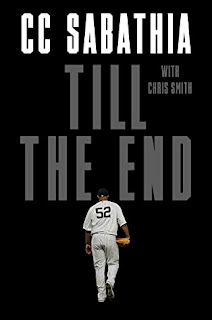
Review of "Till the End"

While I have never been a "fan" of CC Sabathia or any of the three teams he played for, I was intrigued when I saw a copy of his memoir available at my local library.  It was a good read and I certainly learned a lot about the man.  Here is my review of "Till the End"


Title/Author: "Till the End" by CC Sabathia and Chris Smith

Rating: 4 of 5 stars (very good)

Review: As one of the better pitchers in baseball for more than a decade, CC Sabathia was a very public figure, but for a long time he was dealing with a very private battle with alcoholism. That struggle, along with his rise from humble beginnings in northern California and his success in Major League Baseball with the Cleveland Indians (now Guardians), Milwaukee Brewers and New York Yankees is told in his memoir co-written with Chris Smith. It deals mainly with his baseball career at various levels and ends when his baseball career ends with the Yankees when they were eliminated in the 2019 postseason.

From the beginning, Sabathia shares his pain and dealing with the disease of alcoholism and aside from when he talks about his childhood, it remains a topic throughout the book.  He describes himself as one who doesn't hide when he is upset or wants everyone to know what he is feeling and when he decided to seek treatment, that was the same way he announced it.  He didn't go quietly to his manager and sneak to the rehab facility – he told the world about his disease and what it did to him. Like many other public figures who make this type of announcement, he did so with the hope that it might help others in a similar situation.

He tells very good baseball stories from his time playing high school ball as well as his stint in the minor leagues and then with the Indians.  It was in Cleveland where he became an All-Star and helped the Indians make the postseason.  He was comfortable in Cleveland but also knew the business of the game well enough that his trade in 2008 to the Milwaukee Brewers wasn't a surprise – he enjoyed the challenge of leading them to the postseason.  That lead to a big contract he signed as a free agent with the Yankees, with whom he won his only World Series championship in 2009.  He talks of mostly good memories with teammates and managers for all three clubs.

Sabathia also approaches the topics of racism, mainly through his experiences but also because of the shrinking number of Black players in the game.  Most notably, he talks about his time in Milwaukee mainly through being in a larger group of fellow Blacks than with the other clubs.  While nothing he states is incorrect, his stories may come across to some as complaining.  It should also be noted that he repeatedly states that he got along fine with his white and Latino teammates as well, but was just more comfortable around fellow Blacks.

There is a lot of swearing in Sabathia's account so this book is best read only by adults, but they do add a layer of authenticity to the emotions he has when sharing these tales.  Overall, it is a good book and the reader will get to know the true CC Sabathia, just in a slightly over-the-top way at times.  It is certainly one to read if one wants to learn more about him.

Links: Till the End: Sabathia, CC, Smith, Chris: 9780593133750: Amazon.com: Books

Tuesday, June 29, 2021

Review of “Our Team”

This was one of the more anticipated baseball books for 2021 and it lived up to its reputation as it was a fine and easy read on the last championship season in Cleveland. It’s more than just a recap of their 1948 season. Here is my review of “Our Team”

Title: “Our Team: The Epic Story of Four Men and the World Series That Changed Baseball” by Luke Epplin

Rating: 5 of 5 Stars (excellent)

Review: The last time the Cleveland Indians won the World Series, as many know, was 1948. What might not be as well known is they had not one, but two Black players on their championship team just one year after the integration of Major League Baseball. The owner of the Indians, Bill Veeck, was just as determined as Branch Rickey to integrate the sport because he also saw the skills that Black players would bring to his club. Veeck’s story associated with this team is one of the four men highlighted in this very good book by Luke Epplin. 

The two Black players, Hall of Famers Larry Doby and Satchel Paige, took very different paths to get to the clubhouse of Cleveland Municipal Stadium in 1948. Doby was called up to the Indians by Veeck mid season in 1947, just a few months after Jackie Robinson. Unlike Robinson, who had spent time in the white minor leagues after the Negro Leagues and before joining the Dodgers, Doby had no such time to adjust. After Veeck bought Dolby’s contract from Effa Manley and the Newark Eagles, Doby was subjected to much the same harsh treatment as Robinson, but it came as a bigger shock. Doby was also questioning his ability to stick with the Indians - until it all came together for him in 1948 - at least on the field.

Paige was a little different as Veeck’s call to him later in 1948 was viewed by many as a gimmick despite Satchel’s ability to still get hitters out, no matter what his official age was. His story is told in a matter of act manner, just like Veeck and Doby, relying mainly on second hand accounts and research. Some may prefer first hand accounts for this type of book, but it works for this one. 

The fourth man whose story is important to tell for a complete picture of the 1048 Indians is the established star of the team, Bob Feller. He actually struggled during the first half of that season but came on strong in September and the World Series. The intertwining of his story and Paige’s, especially when they were performing on barmstorming teams before becoming Cleveland teammates, was easily the most enjoyable aspect of the book for me. Not just for the baseball, nor for the contrast in what each man got out the games, but for the mutual respect they had for each other. Epplin did very well with this aspect.

Readers who like reading about baseball’s integration as well as Indians fans should be sure to read this book. It is one that while short on direct quotes and material, is chock full of great stories about the four men who helped bring a championship to Cleveland.


Friday, January 3, 2020

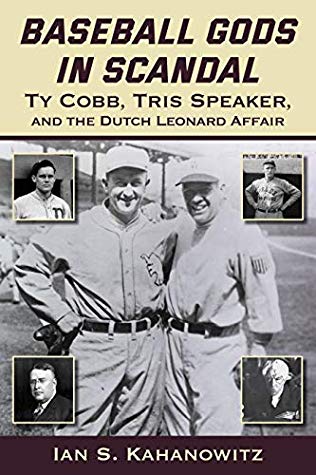
First review of 2020 - "Baseball Gods in Scandal"

Happy New Year to all my fellow sports book readers!  One resolution I am determined to keep this year is to catch up on reviews of books provided to me by authors or publishers but for one reason or another I never got around to doing.  This review is the first book in attempting to keep that resolution as it was sent to me soon after publication in the summer of 2019.  Here is my review of "Baseball Gods in Scandal"

Title/Author:
“Baseball Gods in Scandal: Ty Cobb, Tris Speaker and the Dutch Leonard Affair” by Ian Kahanowitz

Tags:
Baseball, professional, Tigers, Indians, gambling

Publish date:
July 4, 2019

Length:
388 pages

Rating: to
4 of 5 stars (very good)

Review:
The late 1910's and 1920's was a trying time for professional baseball.  Caught up in several gambling scandals, the most famous being the Chicago White Sox throwing the 1919 World Series, the sport was well on its way to cleaning itself up thanks to the iron fist of its first commissioner, Kennesaw Mountain Landis.  However, in 1926 Landis received a letter from former pitcher Dutch Leonard about another gambling problem that season. That allegation, which involved two legendary players, is the subject of this interesting book by Ian Kahanowitz.

Late in the 1919 season, after the White Sox had already clinched the American League pennant and the Cleveland Indians were assured of finishing second, the Indians and Detroit Tigers played a mostly meaningless game.  "Mostly" is the key word here as the Tigers were in a fierce race for third place.  Finishing in the top three of the league was a big deal in those days as the top three teams received shares of the revenue generated from the World Series.  At the time, that was a significant amount of money given the player salaries.  Allegedly, the two biggest stars in that game, Ty Cobb of the Tigers and Tris Speaker of the Indians, were involved in a betting scheme to ensure the Tigers would win and finish third.  That was the subject of Leonard's letter and it set off a firestorm of controversy.

Of course, Cobb and Speaker denied having any involvement in any gambling. Their stories, as well as Leonard's and those of Landis, American League President Ban Johnson (whose feud and power struggle with Landis make for terrific reading) and Smokey Joe Wood, who also supposedly knew about this incident but had conflicting testimony, are captured in great detail by Kahanowitz.  At times, the writing is so detailed that a reader must read it carefully, almost like the transcript of a legal trial.  This review will not contain any spoilers, so one must read the book to know the outcome. 

However, reading the book is something that anyone interested in baseball during that era, or wants to learn more about the main characters mentioned above should do.  It will teach the reader a lot about this mostly forgotten but historic incident in baseball history.

I wish to thank Mr. Kahanowitz for providing a copy of the book in exchange for an honest review.   
                                          
Book Format Read:
E-book (PDF)

Buying Links:

Wednesday, May 8, 2019

Guest post - review of "The Catcher Was a Spy" by Sports Book Lady

This book was another Goodreads discussion and was a very interesting story. Here is the Sports Book Lady's review of "The Catcher Was a Spy."


As a baseball fan, I have always bled Cubbie blue without a doubt; yet, my favorite non Cub players have always been Sandy Koufax and Hank Greenberg. As a Jew with few Jewish stars to cheer for, I get excited every time a Jewish athlete makes headlines. The team Israel entry to the World Baseball Classic two years ago? My son and I woke up diligently at 4:00 to watch their games? Watching the Houston Astros’ Alex Bregman turn into a bonafide star has me kvelling, not to mention seeing Ian Kinsler get traded to the Boston Red Sox last season and then win a World Series ring with the team. Known as people of the book, Jewish stars are few and far between, so I keep my feelers out any time a Jewish athlete does something special, on or off of the playing field. That is why the Moe Berg, a back up catcher during the 1920s and 1930s has always been an intriguing character to me. Recently, there had been a movie produced about Berg’s life, so I jumped at an opportunity to read the book first, The Catcher Was a Spy by Nicholas Dawidoff. 

Moe Berg was born in 1901, the third child of Bernard and Rose Berg. Although the Bergs were ethnically Jewish and all who knew them could easily tell by their physical features, Bernard Berg tried to distance himself as much as possible from any Jewish acquaintances. An immigrant, pharmacist, and self made man, Bernard Berg moved his family to the Roseville section of Newark, New Jersey as soon as he had the means to leave the Bronx, a neighborhood that had too many Jews for his liking. His children Sam, Rose, and Morris, all common Jewish names during the generation, attended public school, had few Jewish acquaintances, and did not attend religious school. Bernard pushed his children to achieve, instilling in them that they could make something of themselves in America if they studied and became a doctor, lawyer, teacher, or nurse. Sam and Ethel followed their father’s advice and became a doctor and teacher respectively, but Morris, known as Moe, the most precocious of the three, although a stellar student from an early age, decided that he would achieve great heights by playing baseball. 

Although Bernard Berg distanced himself from Jews, he could not understand why his son would rather play a kids’ game than be a scholar. Yet, Moe Berg was a scholar, earning a place in the National Honor Society in high school and earning admission in Princeton University. Bernard Berg wanted his son to be a lawyer yet by the time Moe attended Princeton, he was both a top baseball player and excelling at learning foreign languages. He was also a loner having no close friends and learned how to make himself scarce. One minute, Berg could work a crowd, regaling party goers with his exploits on the baseball diamond, and the next he would have disappeared. By the time Berg graduated Princeton with high marks in 1923 and had offers to play ball from multiple teams, he had already had an eye on his future profession, a spy during World War II. Upon graduation, Berg first played for the Brooklyn Robins, later the Dodgers, as the team sought a Jewish star to appeal to Brooklyn’s population. Yet, Berg could not decide whether to pursue baseball or the law, and, as a result, his ball playing skills fell off. 

Moe Berg eventually received his law degree by attending courses at Columbia during off seasons. Yet, his passion was baseball. It was the only profession, he reasoned, where he could travel the country, play a game for three hours a day, and explore cities at his leisure while the rest of his teammates pursued other, unwholesome activities. Berg shattered his knee in 1929, and during the 1930s stayed on major league rosters for the Washington Senators and Boston Red Sox as a third string catcher turned bullpen coach. He established a habit of reading a minimum of ten newspapers a day, walked everywhere, and spoke seven languages well and understood countless other. Berg became known as Professor Berg to sportswriters and developed lifelong relationships with John Kieran of the New York Times and Jerome Holtzman of the Chicago Tribune. Both writers realized that Berg possessed a combination of knowledge and intelligence rare in a major league ball player, and these relationships, as well as his flare for spinning stories kept Berg in the league with Red Sox well after his talents diminished. 

Following off season trips to Japan and the Far East after the 1932 and 1934 seasons that allowed Berg to travel the world, he became relatively proficient in Japanese. When the United States entered World War II, Berg enlisted and gained admission into the Office of Secret Service once officers discovered his penchant for languages and secrecy. Moe Berg was born to be a spy, yet, according to Dawidoff, he was not necessarily an adept one. Berg’s key assignment during the war was to engage axis power physicists to see if Germany had learned how to split an atom and develop a bomb. Berg was likable and developed relationships with all the scientists he met, yet also wrote excessively and failed to keep expense accounts. Because all of Dawidoff’s interviews were second hand, as a reader it is tough to know whether Berg’s stories or Dawidoff’s opinions are closer to the truth. Was Berg a key player in the OSS who was denied a career in the CIA or a man on the fringes who the government wanted to rid themselves of once the war years ended? The truth was probably somewhere in between given Berg’s idiosyncratic behavior, yet like the spy he wrote about, Dawidoff’s readers will never know the full truth of Berg’s wartime exploits. 

Nicholas Dawidoff wrote The Catcher Was a Spy more than twenty years after Moe Berg’s passing. Most of his family and acquaintances were also dead so the author repeats himself and uses the last hundred pages of the book to mention anecdotes of Berg’s postwar travels. These last hundred pages dragged a bit, and at the essence paint a picture of a man denied the job of his dreams who could not reintegrate into civilian life. Moe Berg was the rare scholarly ball player who was a sportswriter’s dream and spoke more languages than most people could even imagine. Yet, with average ball playing skills and a penchant for being a loner, Berg faded from society until Dawidoff published this volume. While today Jewish kids can look up to Alex Bregman, nearly one hundred years ago Jewish kids were kvelling over the ball playing skills of Moe Berg, a Jew and person who chose to live life on the fringes. 

3.5 stars

Tuesday, April 23, 2019

Review of "Son of Havana"

I remembered watching Luis Tiant as a child when he pitched one season for my favorite team, the Minnesota Twins.  He had a good year, but was hurt and later went to the Boston Red Sox where achieved his best seasons.  His life in and out of baseball is captured in his memoir.  Here is my review of "Son of Havana". 


Title/Author:

“Son of Havana: A Baseball Journey from Cuba to the Big Leagues and Back” by Luis Tiant with Saul Wisnia


Tags:
Baseball, memoir, professional, Indians, Twins, Red Sox, Yankees


Publish date:

May 14, 2019


Length:

300 pages


Rating: 

4 of 5 stars (very good)


Review:

One of the most charismatic players to ever don a big league uniform, Luis Tiant was best known for his unusual pitching motion while compiling very good statistics for four teams in the 1960’s and 1970’s.  His story, from the rock-strewn fields in his native Cuba to his glory days in Major League Baseball are captured in his memoir written with Saul Wisnia.


As sports memoirs go, there isn’t anything different in the format of the book as Tiant talks about his childhood, his family, his career in both the minor and major leagues and how he has enjoyed his life after baseball.  He tells many stories about teammates, the camaraderie on the teams, and the most exciting games in which he participated.  The biggest of these games, the two games he started for the Boston Red Sox in 1975, were the best parts of his baseball memoires as it is clear that he enjoyed performing on the big stage.  While he shares mostly positive memoires of his time with the Cleveland Indians (he was always grateful to their general manager, Gabe Paul, for giving him a chance), Minnesota Twins and New York Yankees, it is clear that he relishes his time with the Red Sox best.


This was also evident in his stories about non-baseball events in Boston during that time. Being a dark-skinned Cuban, he was always subject to the prejudice and racism that was prevalent during his playing days, but he never let that make him angry or seek revenge. Instead, he always wanted to prove the racists wrong by being the best pitcher he could be. Tiant was also a beloved figure to people of all races in Boston – this was especially noticed during the unrest the city experienced when desegregation of schools by busing was done in the mid 1970’s. He was a voice of calm during this time that people of all races heard.


What I liked best about the book is how Tiant wrote with his heart on his sleeve about every topic.  The passages about his family, whether about his wife Maria and their four children or his parents, were clearly written with genuine love and affection.  When two United States Senators worked on his behalf to have Fidel Castro allow his parents to visit Luis in the United States, it was a huge relief for Tiant to be able to see his parents again.  When he left Cuba in 1961, he feared he would never see them again.  Reading about the joy he felt when he was able to share his biggest moment in his career, winning a World Series game with his parents present, will make any reader feel the joy.


Baseball fans and readers who followed the game during the period in which Tiant played will enjoy this book as he shares much of his life with readers, including why he had that famous delivery.  No spoilers here – read the book to find out.   


I wish to thank Diversion Books for providing a copy of the book via NetGalley in exchange for an honest review.


Book Format Read:
E-book (Kindle)


Buying Links:


Thursday, February 14, 2019

Review of "The Ultimate Cleveland Indians Time Machine"

Whether or not I am a fan of the team, it is always fun to read about the history of a sports team.  This is especially true of those teams who have had a long dry spell without a championship and the Cleveland Indians certainly fit that description right now.  This book captures some of the more memorable and crazy moments in the history of the team.  Here is my review of "The Ultimate Cleveland Indians Time Machine"


Title/Author:
“The Ultimate Cleveland Indians Time Machine Book” by Martin Gitlin
 
Tags:
Baseball, history, Indians

Publish date:
April 1, 2019

Length:
224 pages

Rating: 
4 of 5 stars (very good)

Review:
As one of the charter teams of the American League, the Cleveland Indians have a long list of exciting seasons, interesting stories and wacky moments.  This book by veteran writer
Martin Gitlin relieves some of them in a fun, page turning book.

Most baseball fans know that currently the Indians have the longest title drought in major league baseball, having gone 70 years since their last championship in 1948.  That of course leads to many heartbreaks and frustrations for the team and its fans. I mention this because while the book certainly tries to remain upbeat, it was puzzling to me to see so many negative or embarrassing stories about the team.  Even when a season or player was successful, some part of the chapter was less than positive. 

 
One example of this was the chapter describing the 1920 season, one in which Cleveland won a thrilling pennant race over the Chicago White Sox and New York Yankees and then they easily defeated the Brooklyn Robins (later the Dodgers) five games to two in the World Series.  However, what produced the most talk in that chapter was the death of Ray Chapman after being beaned by a Carl Mays pitch.  This story, like many others in the book, was described well in this book and if a reader wants to learn more, there are other books that go into greater detail about this and some of the other stories.
 
It should also be noted that the many seasons in which the team did well in the regular season and postseason only to fall short in the end are covered and a reader will feel either frustrated or sad, depending on the ending.  Many memorable eliminations from postseason are shared in the book – the demoralizing World Series defeats in 1995, 1997 and 2016 are all there, but told in a mostly positive tone as the wins are fondly remembered as well as the soul-crushing losses.
 
This isn’t to say that all is doom and gloom in the book.  Indeed, even some of the less-than-positive stories are told in either humor or good cheer.  One example of this is the story of “Super Joe” Charboneau, a one-season wonder who was the Rookie of the Year for the Indians in 1980 and never was a productive player in the major leagues again.  By the end of the chapter, the reader should be happy to learn that he has done well for himself after his baseball career flamed out.  These types of stories and that type of writing make the book a very fast read.
 
Indians fans will certainly want to add this book to their shelves as will any other fan who wants to relive highs and lows of the team.  It does include the absolute low, which came before the team was named the Indians. The first team described in the book is the 1899 Cleveland Spiders, who still hold the record for the worst winning percentage in baseball history. That does set a tone that at least doesn’t stay quite so sad.
 
I wish to thank Lyons Press for providing a copy of the book via NetGalley in exchange for an honest review.
 
Book Format Read:
E-book (Kindle)

Buying Links:
https://www.amazon.com/gp/product/1493040227/ref=x_gr_w_bb?ie=UTF8&tag=x_gr_w_bb-20&linkCode=as2&camp=1789&creative=9325&creativeASIN=1493040227&SubscriptionId=1MGPYB6YW3HWK55XCGG2

 
https://www.barnesandnoble.com/w/ultimate-cleveland-indians-time-machine-book-martin-gitlin/1129321192?ean=9781493040230#/

Saturday, May 13, 2017

Review of "The Pitch That Killed"

This book is one that has been on my radar for several years, but I just never thought about picking it up.  Then in an online baseball book club to which I belong, it was selected as the book for this month.  Decided to read it on the train to and from a baseball game and my only complaint is that I waited so long to read it.  Here is my review of "The Pitch That Killed."


Title/Author:
“The Pitch That Killed: Carl Mays, Ray Chapman and the Pennant Race of 1920” by Mike Sowell
Tags:
Baseball, professional, history, Yankees, Indians, tragedy
Publish date:
September 1, 1989
Length:
330 pages
Rating: 
5 of 5 stars (outstanding)
Review:
Most baseball fans know about Ray Chapman being the only player to die because of an on-the-field incident when he was beaned by Carl Mays. These same fans may also know that he was very popular, not just with the fans of the Cleveland Indians but also is teammates. Then they may also be aware that Mays was not very popular, even before this tragedy, with the players, teammates and opponents alike. 

Just these topics would make a good book, but author Mike Sowell takes these and crafts an even better book by giving readers a complete picture of not only Mays and Chapman and that fateful day of August 16, 1920, but by including so many other key baseball men such as Tris Speaker (the Indians manager), Babe Ruth and Miller Huggins, the reader gets the complete picture of the men involved and the lead-up to that fateful pitch.

Mays was known as a trouble maker before arriving to the Yankees from his days with the Boston Red Sox.  It didn’t affect his pitching as he had success with both teams and was a key member of the Yankees staff as they were involved in a three team pennant race with the Indians and the Chicago White Sox.  His pitching was affected, however by a new rule that was enacted to disallow trick pitches.  Mays’ underhanded delivery was deemed to be this, but he still threw in that manner that was effective and hard for a batter to pick up, as would be horribly on display during an at bat by Ray Chapman.

Chapman, on the other hand, was a young player on the rise with the Indians.  A gifted shortstop, he was becoming a better player and gaining the confidence of his teammates.  Newly married and expecting his first child, the young man seemed to have the world in his hands when he stepped up to the plate during a game against the Yankees. A pitch from Mays was coming in high and tight on Chapman, who never saw it coming.  It hit him in the left temple and he was knocked to the ground bleeding and unconscious.  He was able to make if off the field with help from his teammates, but died the next day in the hospital.

Just this alone would make a good book, but Sowell turns it into fascinating reading by including many details on both Mays and Chapman, such as when Mays told his wife in 1918 that he may have needed to do something “out of the ordinary” to get his name in the papers, or that Chapman may have retired after the 1920 season after promising his father-in-law to consider giving up the game to run their successful family business. Sowell also weaves the tight American League pennant race into the story along with other people that makes story of Chapman’s death even more completing.  Little items such as Speaker getting involved in the decision on where to bury Chapman, a New York writer who tried to implicate Mays in throwing games during the 1921 World Series and the talk of players boycotting any game in which Mays was the pitcher.

All of this and more makes this book one that every baseball fan and historian must read. Even though I had known about this book for many years, I never picked it up until it was selected as a book of the month in an online baseball book club.  My only problem with that is that now I am kicking myself for waiting so long to read it. 

Book Format Read:
Paperback

Buying Links:


Sunday, April 9, 2017

Review of "No Money, No Beer, No Pennants"

Each baseball team, no matter how good or bad they have performed on the field over the years, has a unique history and some very interesting stories. This book shares some of those for the Cleveland Indians during the Great Depression.  Here is my review of "No Money, No Beer, No Pennants."


Title/Author:
“No Money, No Beer, No Pennants: The Cleveland Indians and Baseball in the Great Depression” by Scott H. Longert

Tags:
Baseball, history, Indians

Publish date:
September 15, 2016

Length:
272 pages

Rating: 
4 ½  of 5 stars (excellent)

Review:
After winning the World Series in 1920, the Cleveland Indians didn’t repeat the success again, sinking to new lows by 1928 with a star (Tris Speaker) who retired amidst a gambling scandal, their owner passed away and the value of the franchise was rapidly declining.  However, all was not lost for the team as a new owner and a new stadium would help reverse the team’s fortunes despite the country being deep into the Great Depression. 

In this well written and deeply researched book, Scott Longert illustrates how the Indians were able to overcome this adversity and help convince the voters and local government leaders of Cleveland to build a brand new stadium – Cleveland Municipal Stadium with a capacity of over 80,000. The dealing and construction of the stadium is just one of the many issues affecting the team in which Longert gives the reader sufficient detail to get a clear picture of the issue, who the key people are in the matter and what the final result will be. 

The portrayal of people, from owner Alva Bradley to managers Roger Peckinpaugh and Walter Johnson are also well researched and the reader will follow them through most of the book.  Key players are also included and the same attention to detail is paid to them as well.  From Wes Ferrell and Earl Avirill  to Bruce Campbell (who survived spinal meningitis) to a teenage sensation named Bob Feller, the players are portrayed in a manner that the reader will learn much about them.

The business of the ball club is a main topic throughout the book and that was just as good, if not better, than the writing about the people. Readers will learn a lot about what the team, and the sport of baseball, went through during the Great Depression and how they, like every other industry and business, had to make significant cuts to expenses to survive. The saga of the team moving to the new stadium also made great reading, including the incredible decision of Bradley to move the team back to its smaller, older park in 1934 because he felt the rent charged by the city was too high. 

Readers who are interested in baseball history, even if that interest isn’t concentrated on the Indians, will enjoy this book as it paints a complete picture of the team during that time frame. Indians fans who want to know more about the history of their team and the old “Mistake by the Lake” – the nickname later given to Cleveland Municipal Stadium – will enjoy reading this one as well.

I wish to thank Mr. Longert for providing a copy of the book in exchange for an honest review.

Book Format Read:
Paperback

Buying links:

http://www.barnesandnoble.com/w/no-money-no-beer-no-pennants-scott-h-longert/1123744486?ean=9780821422441


Saturday, February 20, 2016

Review of "Greatness in the Shadows"

When I was learning about Jackie Robinson and what he did for baseball, the name Larry Doby never came up in the literature I read as a kid.  In fact, I never heard of him until he was named manager of the White Sox in the 1970's, long after he played an important role in the integration of baseball.  Therefore, I was very interested in this book on Larry Doby when I saw it was going to be published this spring.  There is a lot of good information in this book about the man.  Here is my review of "Greatness in the Shadows." 


Title/Author:
“Greatness in the Shadows: Larry Doby and the Integration of the American League” by Douglas Branson

Tags:
Baseball, race, history, Indians, White Sox

Publish date:
April 1, 2016

Length:
336 pages

Rating: 
4 of 5 stars (very good)

Review:
The story of Larry Doby is one that not many people remember because even though he was the first black baseball player in the American League, he wasn’t the first one to play Major League Baseball.  While Jackie Robinson’s story is quite well known, author Douglas Branson tells the story of Doby as well, which isn’t much different than Robinson’s for what he had to endure, but under a different set of ballparks and with a different integration pioneer.

Branson makes the case that Doby is just as important a figure as Robinson in the integration of baseball along several fronts. He does take away some of the luster of Robinson’s baseball prowess – not by dismissing what he accomplished – but by comparing the statistics of both men and showing that Doby was Robinson’s equal on the field.  Also, he calls into question the motives of Branch Rickey (while again respecting the work Rickey did) by noting how many of Rickey’s transactions resulted in a net profit to him. Branson gives a lot of credit to Bill Veeck, the owner of the Cleveland Indians, for integrating baseball as well by bringing Doby to the Indians just weeks after Robinson made his debut with the Dodgers.

It is here where Branson starts to question if the reason that Doby and Veeck were not given enough credit for integration because of several factors.  Veeck was not popular with his fellow owners, Doby did not play in New York, which was going through its “golden age” of baseball and therefore did not get the same recognition as a great player as Robinson, Willie Mays, or Mickey Mantle. Of the latter, Branson wrote much about he seemed to be made larger than life by an adoring press and fans.  Like with Robinson, Branson never diminishes what Mays or Mantle accomplished, but did question why they received a lot of fanfare while Doby did not.

Branson also notes that the National League became integrated as a whole and with more teams employing more black players faster than the American League and as a result of that, Doby may not get the attention for what he did as much as Robinson.  He also describes the racial hatred and taunting that Doby received as well. He wants the reader to realize that while Robinson had to endure a lot, so did Doby and he did not have the advantage of preparing for it the previous season in the minor leagues like Robinson did.  Doby was given a baptism by fire.

If this review sounds like it keeps hitting on the same points over and over, this book did the same thing and that made it a difficult read at times. It seemed that Branson was repeating points he was trying to make or certain facts and events over and over. He would repeatedly refer back to an earlier reference by noting the chapter or stating that the point he was making would also be explained in an upcoming chapter. That was a shame because it kept the book from having a good flow and making Doby’s story even more compelling.

Nonetheless, I felt it was a very good source of information for learning more about the first black player in the American League and the case he makes that Doby is underappreciated for what he did for the game of baseball is strong. It just didn’t read as easily as I hoped.  I give the book five stars for the information and three for the writing to make it a four-star book.  I do recommend this book for readers who are interested in learning more about Doby or the integration of Major League Baseball.

I wish to thank University of Nebraska Press for providing an advance review copy of the book through NetGalley in exchange for an honest review.

Book Format Read:
E-book (Kindle)

Buying links (pre-order at time of post):


http://www.barnesandnoble.com/w/greatness-in-the-shadows-douglas-branson/1122887954?ean=9780803285521