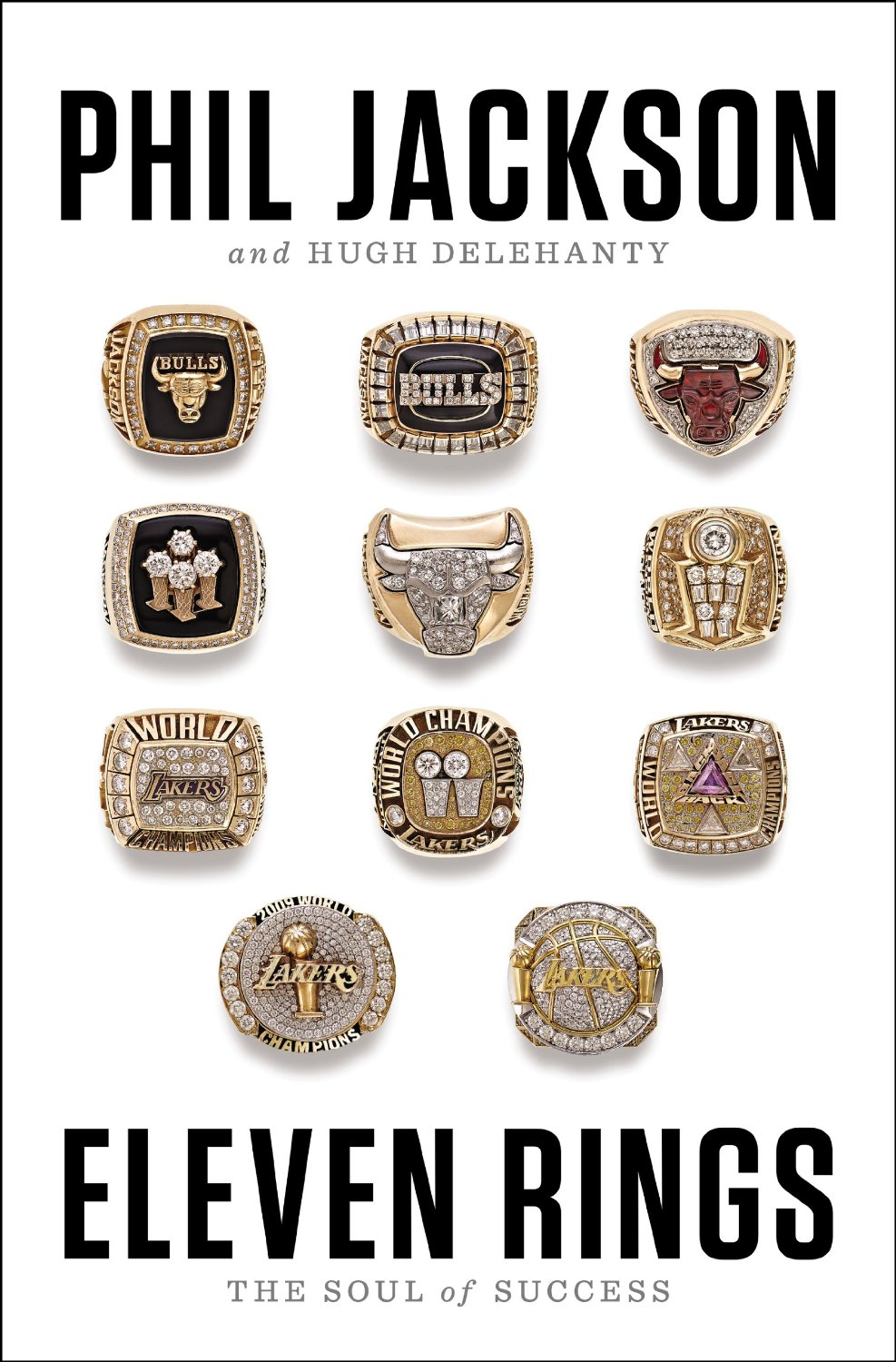
Phil Jackson is the type of coach for whom I have a soft spot in my heart. Because he coached two teams loaded with superstar talent, he and others in similar positions (Joe Torre and Bill Belichek to name a couple) will be told that they got "lucky" because "anyone could win with those players." I never believe that nonsense as it takes a special person to be able to take superstar players with massive egos and blend them together to play well as a team. In the book "Eleven Rings" , Jackson describes just how he did that with two very different types of teams. Here is my review of this book.
Title/Author:
“Eleven
Rings: The Soul of Success” by Phil Jackson and Hugh Delehanty
Tags:
Basketball,
professional, NBA, Bulls, Lakers, autobiography, coaching, Jordan, Pippen, Kobe, Shaq
Published:
May 23, 2013
Length:
393 pages
Rating:
4 1/2 of 5
stars (excellent)
Review:
Phil
Jackson has proven with his previous books that he is as skilled a writer as he
is a basketball coach, and he shows it again with “Eleven Rings.” This book is mostly a recap of his coaching
stints with both the Chicago Bulls and Los Angeles Lakers. He talks about what he had to do to take
these teams that were loaded with talent and make them blend together into a
cohesive team in order to win all those championships.
There are
some aspects of leadership that books about business leadership use. However, Jackson will put a unique spin on
how he might use this model, so that it becomes clear that he is not doing this
from a manual, but instead putting his own perspective and methods into the
work he does with his teams. One of
these is that he often refers to his teams as a “tribe” and each member of the
tribe will know what his role is in order for the goals to be achieved.
What I liked best about Jackson’s sharing of his coaching secrets was how he
treated different individuals differently.
He realized that one method will not work for everyone, and because his
teams had so many superstars with egos to match their talent, he worked on each
individual in methods to which the certain player would most respond
positively.
Jackson described how he did this with his superstar players on each team – Michael
Jordan, Scottie Pippen and Dennis Rodman on the Bulls, Kobe Bryant and
Shaquille O’Neal on the Lakers. I thought the best example of this was how
Jackson handled a situation with Pippen during the 1994 playoffs, when the
Bulls were playing without Jordan who had gone into his first retirement.
Pippen was
supposed to inbound a pass to Toni Kukoc for a last second shot in a playoff
game against the New York Knicks.
Pippen was not happy to have this role for the play and refused to leave
the bench after a time out. Jackson made
a quick substitution for Pippen. Kukoc
made the shot, the Bulls won the game, and the coaching staff decided on what
to do about Pippen. After one assistant
coach told Pippen it was a bad move (in much saltier language), the team said
the Lord’s Prayer, Pippen apologized to his teammates with tears in his eyes,
and everyone got a turn to state how they felt.
That doesn’t sound like much when a team leader says no to the coach in
such a crucial time, but because Jackson knew that this type of action would
affect Pippen greater than a fine or suspension, that is what Jackson did.
It is stories like this, the manner in which Jackson treats his player and most
importantly, how he articulates this in the book is why I believe this is a
book that would be enjoyed by readers of all types, whether or not they are
sports fans. The personal stories in
this book are refreshing, not judgmental, and a source of great information on
some of the biggest names in basketball history. Excellent book.
Did I skim?
No
Did I learn something new?
Yes. While I did know of some of the more
well-publicized events of Jackson’s teams, such as how he handled Scottie
Pippen’s meltdown in the 1994 playoffs or when the Lakers didn’t immediately
offer him new contracts, the manner in which Jackson handled these situations
was telling. These passages delved much
deeper than what was told in the media.
The best of these was how he handled Scottie Pippen’s situation, which
is detailed in the review.
Pace of the book:
Very
good. It moved along nicely and stayed
in chronological order, which is something I appreciate.
Positives:
The manner
in which Jackson describes how he handled many of his players, especially his
best players such as Michael Jordan, Kobe Bryant and Shaquille O’Neal was the
strength of this book. I also liked that
it stuck mostly with basketball-related issues.
Jackson certainly did talk about literature, spiritual life and other
such topics, but instead of full chapters devoted to these topics, he mentioned
them as they related to his teams and/or coaching.
Negatives:
At times,
I found Jackson to come across as condescending toward other teams, players and
coaches that may not have achieved the same level of success as he has
achieved. That has been a consistent
characteristic mentioned by Jackson’s distracters over the years, and it seems
to show in this book. Not enough to be blatant
or libelous but it does appear nonetheless.
I also found a few typos and spelling errors, especially of some
opponents’ names.
Do I recommend?
Yes,
especially for basketball fans. However,
I think that fans of other sports and even some readers who may not be sports
fans, but want to see how successful leaders build teams would like this book.
eBook
(Kindle)
Buying Links: