Showing posts with label science. Show all posts

Saturday, June 13, 2026

Review of "What Makes Olga Run?"

I have been in a bit of a reading funk lately as I not only am trying to figure out which books to tackle on my huge pile - call it task paralysis - but I was also at a professional conference last week and when I go to those, my only consumption of books are audiobooks to and from the destination.  This was the audio book I listened to for this trip and I enjoyed it, even if it may not really qualify as a "sports" book. 

Title/Author:

“What Makes Olga Run?: The Mystery of the 90-Something Track Star and What She Can Teach Us About Living Longer, Happier Lives” written by Bruce Grierson, narrated by Sean Pratt

Rating: 

4 of 5 stars (Very good)

Review: 

As the synopsis of this book says, Olga Kotelko is not your typical 94-year-old woman (at the time this book was published in 2014). She was an elite track and field athlete.  Not only did she run, but she also competed in events like the hammer thrown and the shot put.  In her age category she holds 17 world records and overall, 23.  What makes this remarkable athlete continue to compete at such a high level?  Author Bruce Grierson goes to great lengths to explain why this can occur.

The book doesn’t talk much about Olga’s accomplishments in meets, although the beginning of the book covers much of her athletic achievements.  The book is more about the physical and mental aspects of aging, and how Olga was able to overcome many of the physical downfalls of aging that happen to most people. What was very interesting is that Olga wasn’t someone who had a completely healthy diet, strict sleep patterns or extreme training.  Her regiments are explained by Grierson, but most of the book concentrates on what typical aging people go through and how there can be exceptions like Olga.

Since this makes up the bulk of the book, Grierson does an excellent job of finding many knowledgeable people whose expertise lie in those areas. Sometimes the scientific talk on the audio version, especially when discussing the brain functions, can get a little confusing, but narrator Sean Pratt is very good on keeping the audience not only engaged, but also narrating this without any mispronunciations or other errors.  Grierson also deserves kudos for always bringing the topic back around to Olga and her remarkable ability to perform at this level of athleticism.

Link:   What Makes Olga Run?: The Mystery of the 90-Something Track Star and What She Can Teach Us About Living Longer, Happier Lives: Grierson, Bruce: Amazon.com: Books


Saturday, January 29, 2022

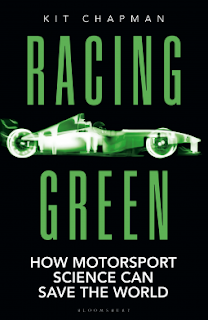
Review of "Racing Green"

It is always a treat when a book turns out to be about more than expected and this was the case with "Racing Green."  Expecting a book on the technical aspects of cars and their switching to electrical power instead of internal combustion, it did have that but so much more that was very interesting.  Here is my review of this book. 


Title/Author: “Racing Green: How Motorsport Science Can Save the World” by Kit Chapman

Rating: 4 of 5 stars (very good)

Review: Auto racing would not be the first sport one would think would be a leader in promoting environmental and scientific awareness but this book by Kit Chapman proves that thought to be false.  The science that goes into building race cars, aerodynamics, fuel and energy efficiency and safety are all quite complex and yet can also be used to help preserve the environment, mitigate climate change, advance health care technology and yes, improve the driving experience of regular travelers and commuters.

Of course, given the title, one would expect that the book would address climate change and the use of electric cars to combat that.  Chapman starts this discussion with that (after providing the reader with a brief history of auto racing) by telling the story of the Formula E racing circuit.  Similar to F1 only in the types of courses they run, Formula E not only uses solely electric cars but they are considered to be the cutting edge for chassis design, energy efficiency and other such advances in the sport.  Other circuits, even NASCAR, have taken notice.  The other interesting aspect discussed about Formula E is how many scientists and engineers work in the industry as their talents are put to use in many different fields.

Speaking of different fields, the book does not concentrate solely on auto racing.  One of the more interesting topics covered by Dr. Chapman in his explanation of how auto racing science helps other areas includes healthcare.  He explains how some of the same technology that makes race car engines more efficient, whether electric or internal combustion, helped make ventilators that were used on patients during the early days of the COVID-19 pandemic more efficient as well. 

Chapman explores a variety of topics and interviews people of both genders in a wide variety of specialties to make the book complete.  It does get very technical and detailed at times, so unless a reader is well versed in the topics, it will take careful reading to fully understand those passages.  It does help that for the most part, the language is such that one doesn’t have to be an expert to at least gain a rudimentary understanding of the science and he uses many excellent everyday examples.

The writing about the sport itself, primarily F1 racing, is done quite well.  This may come across as macabre, but this reviewer believed the best writing was done about two famous crashes in F1.  The first, which shook a young Chapman to the core, was the 1994 crash that killed one of the greatest drivers of all time in any form of racing, Aryton Senna.  The other one was the near death of Romain Grosjean in the 2020 Bahrain Grand Prix, when many of the advances in safety that Chapman writes about were used to save Grosjean’s life when his care was engulfed in flames.  Both times Chapman explained the dangers the drivers faced and it was a good illustration of the tremendous advancements made in safety.

This is the rare sports book that will appeal mostly to non-sports fans as those with interest or careers in science or engineering will appreciate the connections between auto racing and other areas using those concepts.  Race fans, especially F1 fans, will also enjoy not only seeing this connection but also get a good glimpse at the future of the sport.

I wish to thank Bloomsbury USA for providing a copy of the book via NetGalley in exchange for an honest review.

Link: Racing Green: How Motorsport Science Can Save the World: Kit Chapman: Bloomsbury Sigma


Friday, February 7, 2020

Review of "Intangibles"

The title of this book caught my eye as an athlete's "intagibles" always seem to be discussed.  However, that isn't really what the book is about, but instead another trait hard to measure - team chemistry.  This book by Joan Ryan is a very good one on the topic.  Here is my review of "Intangibles"

Title/Author:
“Intangibles: Unlocking the Science and Soul of Team Chemistry" by Joan Ryan

Tags:
Baseball, professional, Giants, science

Publish date:
April 28, 2020

Length:
272 pages

Rating: to
4 of 5 stars (very good)

Review:
"Team chemistry" is a trait that doesn't have a true scientific definition, yet is accepted as a necessary element in a championship team, no matter which sport.  Journalist Joan Ryan decided to look into this trait further to see if there was some scientific truth behind "team chemistry" as well as share stories from players who are credited with elevating this trait.

While Ryan writes about several teams in the book, including the Golden State Warriors and Oakland Athletics, she dedicates most of the material to the San Francisco Giants, a team with who she has worked in the past eight years.  For the scientific aspect, she interviews experts in areas such as neuroscience and psychology and their input lead credence to the thought that good team chemistry is necessary.  However, like the players and managers interviewed, that is not a unanimous consensus and most likely never will be.

However, what makes this book fun to read are the stories by and about players who have been credited with affecting team chemistry whether positive or negative.  Ryan has a label for most of these such as a "super-carrier" – Jonny Gomes, a utility player who found a way to help each of his teammates.  There is the "super-disruptor" – Barry Bonds, and the story he shares with Ryan is worth the time to read no matter one's opinion on his behavior or legitimacy to the home run record. There is a chapter on Mike Krukow, a long time Giant player and broadcaster called "Humm-Baby".  These are just a few examples of the extensive research Ryan put into the project and the finished product is a fun read.

At the end of the book, Ryan does answer two questions about measuring chemistry (can't be the same as sabermetrics) and what is the function.  This review won't give that away, as it is recommended that all baseball fans pick up this book to find out the answers.

I wish to thank Little, Brown and company for providing a copy of the book via NetGalley in exchange for an honest review.
                                    
Book Format Read:
E-book (Kindle)

Buying Links:

Sunday, May 19, 2013

Review - Extra Innings by Bruce E. Spitzer


Title/Author: “Extra Innings” by Bruce Spitzer
Genre: Fiction, sports, baseball, Ted Williams  
Published: October 16, 2012
Length: 386 pages

Rating:  4 of 5 stars – very good

Review:
When baseball legend Ted Williams died in 2002, his son John Henry wanted to preserve the DNA that made him one of the greatest hitters in the history of Major League Baseball.  A process called cryogenics was used to preserve his genetic makeup.  But could this really be used to recreate a baseball legend?

Bruce Spitzer’s novel “Extra Innings” gives us a glimpse of what might happen with this science.   In the year 2092, William’s head and brain are surgically attached to the body of a young tennis player who died in an accident.   The surgery is performed at the CryoCorp headquarters by the world-renowned Dr. Elizabeth Miles.   What follows is a story that covers many topics and may even be considered a futuristic biography of Williams.
Being a reader of sports books first and foremost, I was not disappointed with the baseball aspects of the book.   These did not take place until about 25% into the book, as Williams had to first adjust to his new body in a new era.   Major League Baseball is much different than during the “first” Williams’ time, with teams all over the globe, a longer season of 200 games thanks to warmer weather, and the elimination of human pitchers.  His introduction to the “Botwinder”, the robot pitchers who use technology to throw fastballs at 120 miles per hour, was one of the many humorous parts of the book.  

Another aspect of the game that is addressed is the use of performance enhancing drugs.   In 2093, the first season in which Williams plays for the Boston Red Sox, every player is using some form of a drug.  Williams staunchly refuses to do so, and initially performs remarkably well without them.  Without giving away too much of the baseball story, Williams and the Red Sox both have roller coaster rides during the second baseball career of the “Splendid Splinter.”
However, there are some baseball traditions that are kept.  Despite most of Boston being flooded now, Fenway Park still exists, complete with the Green Monster, but is now called Fenway Island.  Players (human ones, anyway) are still introduced and take their place on the baselines to applause by the fans, and caroms off the Green Monster still are tricky.

Spitzer develops the “second” Ted Williams character with painstaking detail, ensuring that his personality, characteristics and mannerisms are kept the same as the person Red Sox fans in the 1940’s and 1950’s grew up worshipping.   Williams was as well known for his love of fishing, his foul language and his dedication to the military (Note: there is a lot of cursing in the book by Williams, so younger readers and parents should take note).  Ted even repeats history by interrupting his baseball career in 2093 by joining the Marines by becoming a pilot.
Military combat is next for Williams, and the book does a good job of placing the reader in the cockpit of his plane and in his mind.  When Williams’ wingman is killed after her plane is hit, the reader feels the anguish in his mind.   Even those who have never served in the military can feel comfortable reading this and will understand the camaraderie that is shared by Marines.   The second Ted Williams underscores the Marine motto of “Semper Fi.”

Spitzer also touches on other topics that can be considered controversial, and does a good job of not tipping the reader or the story one way or the other about them.  These include climate change, the existence of Heaven, and the aforementioned performance enhancing drug use in baseball.   The climate change has already taken place with warmer temperatures year round and the flooding of some major cities. 

Ted has many more ups and downs during this second life, including brawls, romance, time with children (another aspect of Williams that is remembered here – the time he spent in hospitals with kids) that is wonderfully portrayed in his interactions with the young son of Dr. Miles, Johnnie.   These are all interwoven in the story of the baseball season and the military missions.  No one part of the story seems to be interrupted when another is taking place – they are all interwoven together to create a well-written novel that is worth the time to read.  A very good look into the possible future of cryogenics, baseball and life.

I wish to thank the author for providing a copy of the book in exchange for an honest review.
Did I skim?
During the military combat chapters, I did skim a few of the paragraphs with more complex military vocabulary.  As long as I understood what was happening, such as the jets being fired upon, I felt that I was still able to follow the story.  No skimming during any other chapters.

Did I feel connected to the characters? 
Yes.  Even though this story takes place 90 years into the future, the reader will feel no different when any of the characters are speaking.  Whether Ted is in the CryoCorp lab just after he is reanimated, on the baseball field, in the cockpit of his fighter jet, or even just having a chat with Johnnie, the reader is right there.   The other characters are portrayed just as well, especially Dr. Elizabeth Miles and her son Johnnie.

Pace of the story:
Very good.  Whether the topic is Ted adjusting to life in the late 21st century, the action taking place at Fenway Island, or flying missions over the Middle East, the story moves along and does not get bogged down in too many details.

Positives:
All topics covered, including baseball, science, and military, are well researched and written in language that will be easy enough for a reader not familiar with them to understand, but at the same time not too basic as to bore those with a lot of knowledge of the topic.

The more controversial topics were handled well.  While the story does show what would happen if one side of the issue happened (i.e. for climate change, the world’s temperature did rise enough to melt ice caps and in baseball, players are using performance enhancing drugs), Spitzer does not portray these as controversial.  His writing simply describes them as something that happened or is taking place now and the world is adjusting. 

Negatives:
At times, I did feel that the particular topic was getting to be too dominant.  Depending on where I was in the book, I wondered if there would be a very long section on science, on Ted’s budding romance, or on military fighter pilot training.   These suspicions did not last long, however, as when this started to kick in, another chapter with another topic began.  Hence, the good pace to the book.

Do I recommend?  
Yes.  This book covers many topics that will appeal to a wide range of readers.   There is enough baseball action that sports fans will enjoy it, but also readers who like political topics (climate change), military topics (Middle East conflict), and romance will also enjoy this book.

Book Format Read: ebook (Nook)

Author Media Links: